Overview
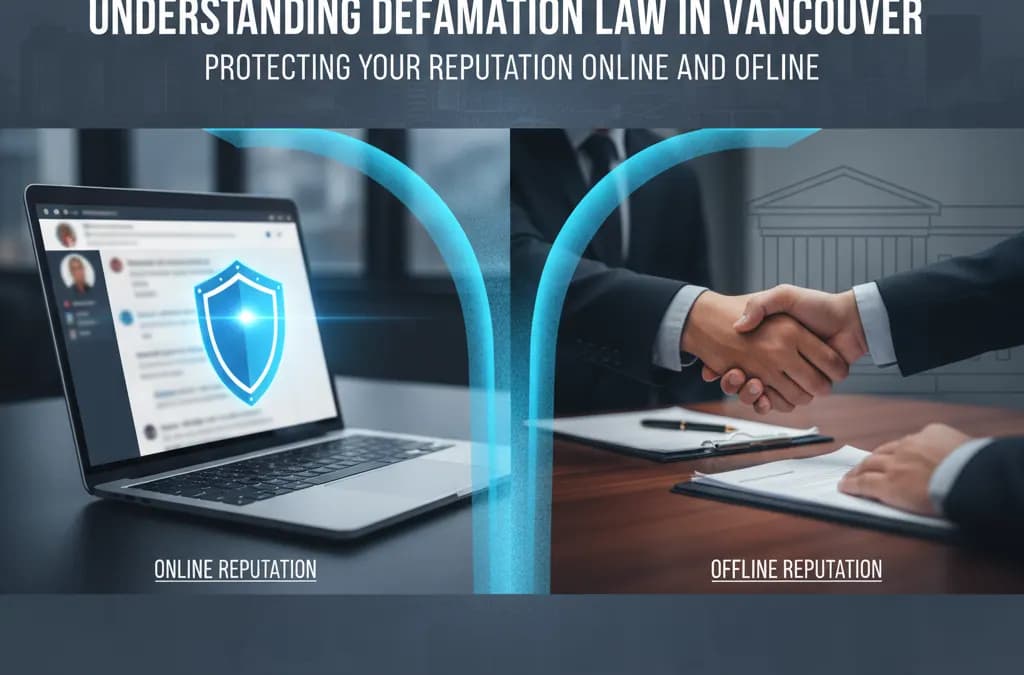
In an age where information spreads instantaneously, both online and offline, safeguarding your reputation has become more critical than ever. False and damaging statements can have profound professional, personal, and financial consequences. In British Columbia, defamation law provides a legal framework to protect individuals and organizations from such harm.
This post will demystify defamation law in Vancouver and across BC, outlining what constitutes defamation, the nuances of proving a claim, and practical steps you can take to protect your good name.
What is Defamation?
At its core, defamation is the publication of a false statement about a person or entity that tends to lower their reputation in the estimation of right-thinking members of society generally. It can take two forms:
In British Columbia, the distinction between libel and slander is less critical than in some other jurisdictions because the Libel and Slander Act (R.S.B.C. 1996, c. 263) largely treats them similarly, particularly regarding the need to prove special damages.
- Libel: Defamation in a permanent form, such as written words (e.g., newspapers, books, emails, social media posts, websites), images, or broadcasts.
- Slander: Defamation in a transient or spoken form (e.g., verbal statements, gestures).
Elements of a Defamation Claim in BC
To successfully sue for defamation in British Columbia, a plaintiff generally needs to prove three key elements:
Crucially, in BC, the plaintiff does not initially need to prove the statement was false or that the defendant knew it was false. Falsity is presumed, and the burden shifts to the defendant to prove the statement was true (the defence of justification).
- The Statement Was Defamatory: The words, in their natural and ordinary meaning, must be capable of lowering the plaintiff's reputation. This is an objective test – would a reasonable person understand the statement to be damaging?
- The Statement Referred to the Plaintiff: It must be clear that the defamatory statement was about the plaintiff, even if they are not explicitly named. Context and surrounding circumstances are crucial.
- The Statement Was Published: 'Publication' simply means the statement was communicated to at least one other person besides the plaintiff. This is a very low bar, especially online. A single tweet, Facebook post, or even an email sent to one recipient can constitute publication.
Defences to Defamation
Even if the three elements above are met, a defendant may have several defences available:
- Justification (Truth): The most powerful defence. If the defendant can prove the defamatory statement is substantially true, the claim will fail. The burden of proof for truth lies with the defendant.
- Fair Comment: This defence applies to expressions of opinion on matters of public interest. To succeed, the comment must be based on true facts, be recognizable as an opinion, relate to a matter of public interest, and be one that an honest person could express.
- Absolute Privilege: Protects statements made in specific contexts, such as during parliamentary proceedings or judicial proceedings. These statements are immune from defamation claims, regardless of their truth or malice.
- Qualified Privilege: Applies when the person making the statement has a legal, moral, or social duty to do so, and the recipient has a corresponding interest in receiving it (e.g., employer references, police investigations). This privilege can be defeated if the plaintiff can prove the statement was made with malice (i.e., the defendant knew it was false or acted with reckless disregard for its truth).
- Responsible Communication on Matters of Public Interest: A relatively new defence in Canada, this protects journalists and others who publish defamatory statements on matters of public interest, provided they acted responsibly in gathering and disseminating the information.
Defamation in the Digital Age
The internet has amplified the reach and impact of defamatory statements. Social media posts, online reviews, and website content can be seen by thousands, if not millions, instantly. This means:
- Jurisdiction: Online defamation can have a global reach, raising complex jurisdictional issues. However, if the harm is felt in BC, a BC court may have jurisdiction.
- Anonymity: While some online platforms allow anonymity, it's often possible to unmask anonymous defamer through legal channels.
- Perpetuity: Online content can remain accessible indefinitely, causing ongoing harm.
Practical Advice: Protecting Your Reputation
If you are a victim of defamation:
If you are accused of defamation:
- Document Everything: Take screenshots, save links, and record dates and times of the defamatory statements. Preserve evidence of the harm caused (e.g., lost business, emotional distress).
- Do Not Retaliate: Engaging in a back-and-forth online can exacerbate the situation and potentially expose you to a counter-defamation claim.
- Consider a Demand Letter: A lawyer can send a formal letter demanding retraction, apology, and/or removal of the defamatory content. This often resolves matters without litigation.
- Seek Legal Counsel: Consult with a lawyer experienced in defamation law in BC. They can assess the strength of your case, advise on potential remedies (damages, injunctions), and guide you through the legal process.
- Do Not Delete Evidence: While tempting, deleting posts or comments can be seen as an admission of guilt or an attempt to obstruct justice.
- Seek Legal Counsel Immediately: A lawyer can advise you on potential defences, negotiate on your behalf, and represent you in court if necessary.
Conclusion
Defamation law in British Columbia serves as a vital tool for protecting individuals and businesses from the damaging effects of false statements. Whether online or offline, understanding your rights and obligations under this complex area of law is crucial. If you believe your reputation has been unfairly harmed, or if you face an accusation of defamation, prompt and informed legal advice is your best course of action.